
A policymaker wants to fund a reskilling programme for displaced workers in Africa
How an AI book companion can help


95 percent of university students in the UK use generative AI. Corporate documents are ‘saturated’ with AI-generated language. Even in 2024 (the early days of the LLM boom), 14 percent of UN press releases involved LLM-assisted writing.
What chance does an academic book stand of influencing policy in the face of shrinking attention spans and growing workloads? Not exactly famous for high readership even before the rise of LLMs, the academic monograph of several hundred pages is surely prime fodder to be fed into the expansive context window of the newest models. (It helps that many are readily available in PDF from the publisher, unlike the non-fiction titles found at your local bookstore.)
I am a big fan of the hard skill of sitting with a book and evaluating its arguments. But I’m also a realist, and the direction of travel, to me, is clear. Civil servants, policymakers and politicians will use AI to sift through vast swathes of documents to gather evidence and design policy. The best bet may be to co-opt this process.
Introducing AI book companions
Jeffrey Abbot and Andrew Maynard created an ‘AI Companion’ version of their book, AI and the Art of Being Human, earlier this year. It’s a Markdown text file that you upload to an AI chatbot and use alongside your reading of the book. Andrew elaborates on the rationale here:

In 2024 my book Revisiting Africa’s Flagship Universities: Local, National and International Dynamics was published by African Minds. I’ve reworked the text into an LLM-friendly Markdown version, following the format of Abbot & Maynard, and African Minds are kindly hosting on their website here (grab the Markdown file and the original PDF).1
How does it work? Simply upload the Markdown file to your chatbot of choice, and say something like:
Follow the instructions in this file, then ask me what I'd like to explore.
Importantly, Maynard notes that this works best with the most powerful versions of Claude, Gemini or Grok with reasoning enabled. It didn’t work so well with ChatGPT, due to the way it processed large files. They were using ChatGPT 5.2, and 5.5 may be better (I haven’t tested yet).2
The file includes more detailed instructions at the start for humans, and then a section for LLMs, before the main text.
An example conversation
The best way to demonstrate why this may be useful is a sample conversation: read my chat with Claude here.3
In this conversation, I pretend to be a well-meaning policymaker interested in funding a reskilling programme for workers who may be exposed to AI in sub-Saharan Africa. I ask it to tell me whether my work is likely to be successful, any challenges I am likely to face according to the evidence, and the likelihood of sustained long term impact. I’m also interested in tailored reading recommendations.
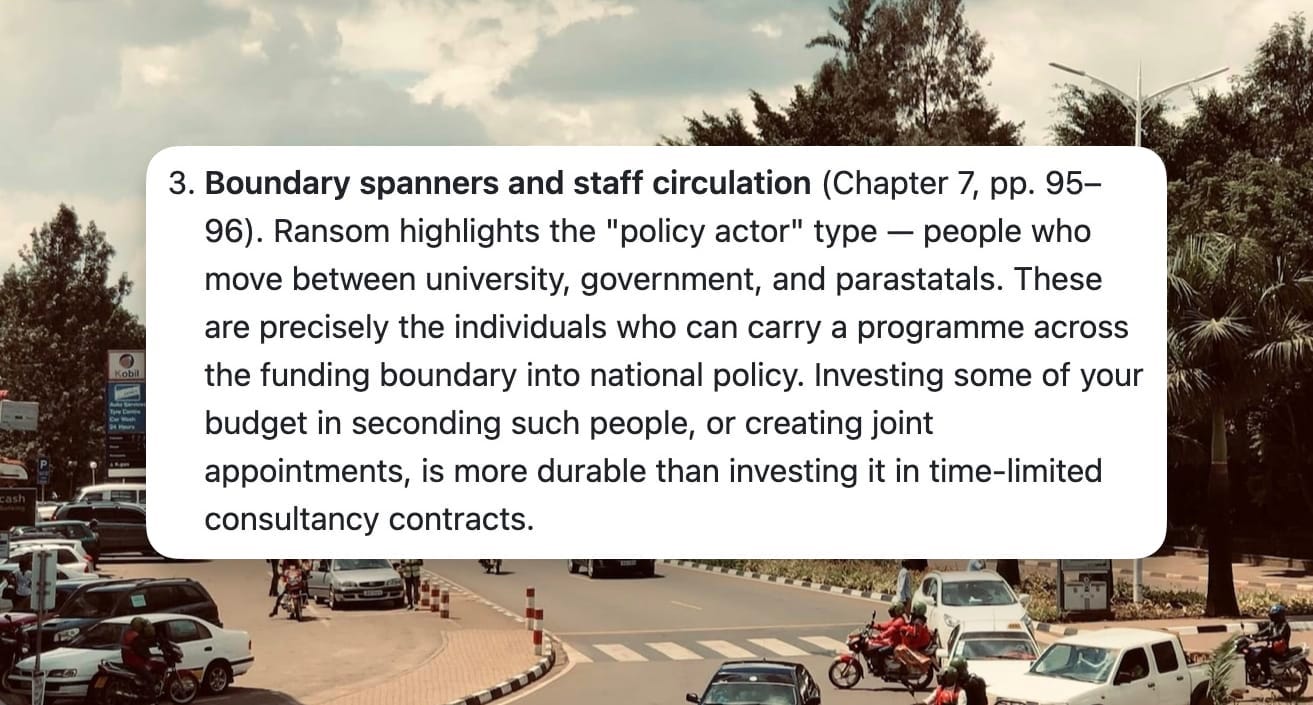
I know the book very well, having spent years of my life writing it, and I am happy with Claude’s responses. It offers a realistic assessment of our policymaker’s ambitions, and accurately draws on findings throughout the book, referring the user to specific pages to learn more.
The overall appraisal is also spot on: in this case, that the proposed work is very hard to get right (and hence avoids sycophancy), and importantly Claude acknowledges that the book doesn’t directly address our fictional policymaker’s question of AI-driven displacement, but draws on the frameworks that apply equally to institutional programmes. (Interestingly, Claude prompts the user to visit this very Substack – which wasn’t part of my design!)
Have a go by downloading the files here, check out Abbot & Maynard’s AI Companion here, and I welcome any feedback.
I adopted Abbot & Maynard’s format with their permission; their book is also licensed under Creative Commons.
Why not just upload the PDF and ask questions? Short answer: it preserves the text better and can encourage a more interactive exploration of the original book. A longer answer: (1) LLMs process Markdown files much more efficiently than PDFs, (2) companion Markdown files include explanatory information and instructions for the LLM to help the reader get the most out of the text, (3) the file is formatted so the LLM can return exact page numbers, can read tables, can grasp headers and subhead structure more easily, and so on, and (4) in this case, I included machine-readable versions of the figures, some of which (like a sprawling decision tree) would otherwise have been lost or mangled.
I used Claude 4.7 Opus with Adaptive thinking, in incognito mode.
Love that you did this James!! Hope it drives a lot more readers/users of the book.